Monday, October 17, 2011

Losing their religion


Judges continues the history of the Israelites after Joshua.

It tells of the early period in their history when they were governed by rulers called judges.

And starts off with a fairly gruesome mutilation by the dismemberment of the thumbs and big toes of the Canaanite king Adoni-bezek.

It goes downhill from there.

I must not have read Judges in the past.

Because I sure don’t remember the carnage that is reflected in it.

Sure, I remember the story of Samson.

But I either wasn’t aware of or didn’t appreciate some of the details.

I had a vague recollection that Samson was a nazirite (meaning “one consecrated"), who from birth was to refrain from all things unclean and was not to cut his hair.

But I didn’t realize that killing the lion (and eating honey from its carcass) and touching the jawbone of an ass was unclean.


Now that I've actually read the Pentateuch, I can make the connection.


Samson touching unclean things

And that symbolized the ruler of the Israelites’ natural tendency to violate God’s rules.


Which seems to me to be the point of the book of Judges.

It depicts the loss of morality and faith of the Israelites in a downward spiral of cyclical relapse to the worship of other gods.

Local gods of the indigenous peoples displaced by Joshua’s conquest of the Promised Land, in addition to the gods of the neighboring peoples of the Trans-Jordan.

Peoples including the local Philistines, Canaanites, Sidonians, Hivites, Hittites, Amorites, Perizzites, and Jebusites.

And the neighboring Aramites, Amalekites, Ammonites, Midianites, Maonites, and Moabites.

Many different peoples, with many different gods (including Baal, Astarte, Moloch, Chemosh, and Dagon).
Astarte, concubine of Baal

God (that is Yahweh, the Israelites’ God) determined to preserve those peoples (and their gods) so as to test the faith of the Israelites.

To see whether or not the Chosen People would take care to walk in the way of the LORD.

Unfortunately, the Chosen People’s track record as reflected in Judges is not so good.

As a matter of fact, it’s terrible.

Judges tells the story of repetitive cycles of apostasy and transgression, leading to defeat and subjugation, causing the Israelites to seek repentence and atonement, where God provides a deliverer from those who plundered the Chosen People.

And of how those deliverers are increasingly flawed.

The early judges appear to have been fairly righteous in delivering the Chosen People.

Although a little violent.

Suffice it to say, as shown by the story of Ehud, if a judge comes up and says: “I’ve got a message from God for you,” you might want to start looking for the exit.

And, as shown in the Song of Deborah (viewed by some as the oldest portion of the Bible) celebrating the exploits of Jael wife of Heber the Kenite and the assassination of Sisera, camping with a judge’s messenger can also be a hazardous activity.
Deborah singing her song

A tent peg to the head is a hard way to go.
Jael and Sisera

Integrity with the law begins to slip in the later judges.

Such as the creation of an idol by Gideon/Jerubbaal from Ishmaelite gold to which the people prostituted themselves.

(And, if you’ve been following what has been said about some present day wanna-be leaders and what they say about being called by God to do His work, the tests and signs sought by Gideon weren’t for the fleece to be wet twice, but wet once and dry the second time.

Oh well, right? Big deal.

So what if they got the story wrong. Who cares?

Other than perhaps God.)

Or in the making of oaths by Jephthah, which ends up causing him to sacrifice his virgin daughter.
Jephthah's daughter

Highly ironic since he was delivering the Israelites from the Ammonites, who worshipped Moloch.

And Moloch demanded sacrifice of human children.

Internal conflicts begin to develop within the Chosen People.

Herem (“utter destruction”) moves from application in external wars against foreign peoples and starts to occur in an internal domestic civil war amongst the Israelites.

Which is where the word “Shibboleth” comes from.

Because the Ephraimites couldn’t pronounce the secret word, dropping the initial “h.”

Which gave them away, and they ended up on the edge of the sword from the Gileadites.

Civil disturbance continues with Micah creating an idol from the silver he stole from his mother, which is subsequently stolen and used for worship by the tribe of Dan.

Which, if the second “word” had been considered (that being the second commandment not to make graven idols), would have instead been destroyed.

But the Israelites have gone astray.

All the people did instead what was right in their own eyes.

Which culminates with the story of the wayfaring Levite’s concubine and the tribe of Benjamin.

One of the weirder bible stories of which I had previously been ignorant. 

And it’s a real doozey.

Almost has an “A Rabbi, a Hindu, and a Catholic Priest walk into a bar…” joke ring to it.

But without a funny punch line.

The tribe of Benjamin had become “a perverse lot,” degenerating to the point of roving bands seeking sexual gratification with strangers to their territory, and set upon the house of an old man who had provided hospitality and shelter to a wandering Levite who had been passing through with his concubine in Gibeah.

As did Lot in Sodom, the old man offers his virgin daughter to satisfy the unruly crowd, but to no avail.

So the wayfaring Levite throws his concubine to the mob outside.

Where she is wantonly raped throughout the night by the men of the Tribe of Benjamin, and left to die on the old man’s doorstep the following morning.
The wayfaring Levite and his concubine

And is subsequently dismembered by the wayfaring Levite.
Sending a message

Who thereafter sends the pieces throughout Israel to the Twelve Tribes with this message:

Has such a thing ever happened since the day that the Israelites came up from the land of Egypt until this day?

Consider it, take counsel, and speak out.

An out roar ensues, and several more cycles of internal herem are implemented, where most of the house of Benjamin is put to the edge of the sword.

The survivors are cursed by the sworn oath of the remaining tribes never to give their daughters in marriage to a Benjaminite.

They must have forgotten about Jephthah and the problems that can happen with oaths.

Of course, the people immediately regret cutting off one of their own tribes, and try to figure out a way around their oath made in the heat of the moment.

They determine to provide wives for the surviving Benjaminites by devoting to destruction all of the inhabitants of Jabesh-gilead (who had sat out the herem against the house of Benjamin, and thus had not made any oath) except young virgins, and through the rape of the young women of Shiloh (ironically, the location of prior unity in the initial distribution of the Promised Land to the Twelve Tribes).
The Benjaminites and the virgins of Jabesh-gilead

Clearly, the system of judges to maintain law and order (so to speak) among the Israelites (let alone their holiness) isn’t working.

Maybe they need a king.

Saturday, October 15, 2011

Bloodbath in the Promised Land

After God's provision of the Law (the Ten Words and underlying ordinances) in the Pentateuch (the first five books), the Bible enters a collection of books described as the Historical Books.


The first of these books is Joshua.


Which describes the Israelites' entry into the promised land.


And its conquest.


Joshua, as you may recall, was a Benjamite, and was originally named Hoshea until Moses changed it to Joshua.


Hoshea/Joshua was one of the initial spies into the Promised Land under Moses, who along with Caleb reported back that, although they were way outnumbered by humanly superior forces, the Israelites could take the native inhabitants.


Because God was on their side.


Unfortunately, the Israelites lost their nerve based on the reports from the other 10 spies that there was no possible chance of success.


And that ticked God off.


So much so that the "sinful generation" had to die off wandering in the wilderness for forty years until only Joshua and Caleb were left.


And Joshua learned his lesson.


When God says attack, you attack.


Be strong and courageous.


Joshua is shrewd enough to implement some simple rules for success in armed combat.


Which are:


     1) Infiltration and recon;
     2) Use only fearless troops;


Oh, and, most importantly:

     3) Always have God on your side.

The commander of the Army of the LORD appears to Joshua

Prior to bringing that Israelites across the Jordan, Joshua sends out spies to evaluate what they're up against in the Canaanite city called Jericho.

And the spies end up hanging out with a prostitute by the name of Rahab.

Rahab had heard about the way that the Amorites to the east of the Jordan through God's power had been "utterly destroyed."

Which is the Hebrew word "herem" when used as a verb.

Rahab is spared from utter destruction
And she believed in that power, and cuts a deal to help out the spies so long as she and her family escape God's herem.

Herem also can be used as a noun, meaning "devoted thing."

And right before the walls of Jericho come tumbling down, Joshua tells the Israelites to steer clear of the things devoted to God's destruction.

It's God's herem.

Perhaps it was all the marching around and horn blowing for a week, but one of the Israelites couldn't help himself.

Whose name was Achan.

And took some herem for his own from the spoils of Jericho.

Which comes back to haunt the Israelites at the city of Ai.

With the success of Jericho, the Israelites believe that the smaller city of Ai will be a piece of cake, and send in a smaller force in the initial attack.

And is quickly turned back in defeat.

On that day God was not on their side.

Due to the fact Achan had taken some of God's herem.

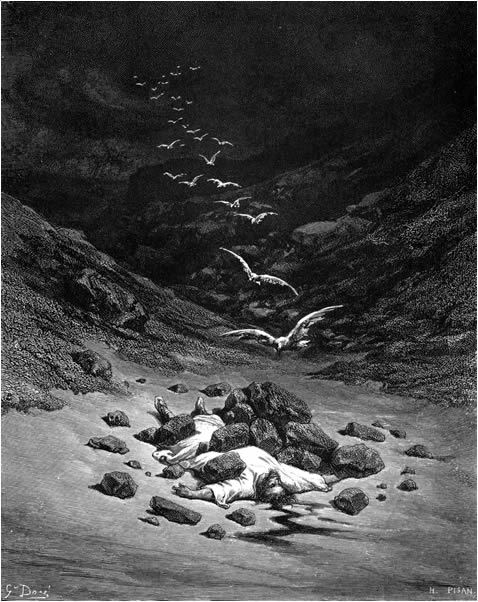
Achan ultimately confesses, and is thereafter promptly stoned to death for his sin.
The stoning of Achan

And the Israelites learn their lesson to stay away from God's devoted things.

And Ai and all its inhabitants are thereafter put to the edge of the sword and subjected to "utter destruction."

The herem of Ai

Because God is now on the Israelites' side.

The conquest of the Promised Land continues through the southern campaign, and then into the northern campaign, until the indigenous local peoples submit or wind up as herem.

The territory is thereafter split up by lots at a place called Shiloh (ironically, the "House of Peace") and allocated to the Twelve Tribes, which straddle the Jordan with two and a half tribes taking the land of their choice on the east bank. 

And the Israelites proceed into the time of Judges.

Friday, October 14, 2011

Once more, with feeling

Due to the sins and transgressions of the Chosen People, Moses is punished vicariously and cannot join them across the Jordan.

And just when you thought everyone else would be crossing over into the Promised Land, Moses makes some time to give a pep talk to the Israelites and to take a final shot at getting the tribes to accept and follow the rules.

God's rules.

Moses Sees the Promised Land from Afar.
And that is what the Book of Deuteronomy is all about.

The Second Law.

Which is pretty much the same as the first law.

The Ten Words and accompanying ordinances that the Israelites have been presented several times in a variety of different forms throughout Exodus, Leviticus, and Numbers. 

But Moses wants his people to understand that they won’t get too far without it.

And uses his last chance to embellish the point.

Much of Deuteronomy is reported in the first person.

And provides what one in the future will contend is the first of the two absolute rules upon which all the rest of the law of the prophets is based:

Love the LORD your God
with all your heart,
and with all your soul,
and with all your might.

If you’ve been following along, you already know what the second absolute rule will be.

It’s in Leviticus.

And it isn’t any of the rules about ritual animal sacrifice.

It’s the one which requires the faithful to love their neighbor as themselves.

Moses also provides several pithy observations:

One does not live by bread alone,
but by every word that comes from the mouth of the LORD.

and

Since there will never cease to be some in need on the earth, I therefore command you,
“Open your hand to the poor and needy neighbor in your land.”

There are also several rules which might at first glance be somewhat obscure.

Rules, for example, regarding execution by hanging, property transfers through intestacy, and fair fighting.

Anyone hung on a tree is under God’s curse, and is to be buried the same day.

This might be something useful to remember for further understanding of things that happen later in the Bible.

Inter-spousal marital property transfers are followed by a ritual known as “passing the sandal,” where the succeeding owner takes off their shoes and waves them in the predecessor’s face.

Passing the Sandal

And, for the surviving wife of a marriage without male heirs, if her brother-in-law will not “perform the duty of a husband’s brother,” then she also gets to spit in his face.

Whose name will thereafter be “He who has his shoe untied”.

This might also (believe it or not) be something useful to remember for understanding of things that happen later in the Bible.

As to rules of fair fighting, amputation of the hand is required punishment for any woman who tries to break up a fight between her husband and another man using the technique known in modern times as “the iron claw” (i.e., grabbing the crotch).

Kind of like the Marquis of Queensbury rules.

To the extreme.

Scratching out eyes might be a kosher move, but ladies shouldn’t try anything below the belt.

Because you will be shown no pity if you do.

Not sure if this will be all that useful for further understanding of anything that happens in this Bible.

I can’t see how it will ever come up again.

But one never knows.

As to important things to remember, Deuteronomy, the Second Law, and with it the Pentateuch, the Five Books, concludes with Moses leaving the Chosen People with both blessings and curses.

Their pick.

The blessings of following the rules and obedience to God’s word are peace and prosperity in the Promised Land.

The curses for disobedience and rebellion, are, well, not so good:


The LORD will give you a trembling heart, failing eyes, and a languishing spirit.
Your life shall hang in doubt before you;
Night and day you shall be in dread, with no assurance of your life.
In the morning you shall say, “If only it were evening!”
and at evening you shall say, “If only it were morning!”----
because of the dread that your heart shall feel and the sights that your eyes shall see.

You shall become an object of horror, a proverb, and a byword among all the peoples where the LORD will lead you.


The choice, according to Moses whom the LORD knew face to face, is simple:

I have set before you today
Life and prosperity
Death and adversity.

Choose life so that you may live.

At the time Deuteronomy was written, there had never arisen a prophet like Moses.

The Death of Moses
Nevertheless, it promises that God will raise up another like him.

We'll see who that might be.

Tuesday, October 11, 2011

Are we there yet? Part II

Some events of note are accounted for in Numbers which occur during the extended trip that was necessitated to allow for the “sinful generation” to die off in the wilderness.

There is a talking animal.

Which would be Balaam’s ass, the only animal other than the serpent in Eden reported to speak in the Bible.

Balaam's Ass
The donkey that could see the angel of the LORD, and tried to stop the seer who had been sought out by the Moabite Balak to issue a curse against the Israelites.

Who tried to help out his longtime master by not taking him to his doom.

Balaam was not an Israelite, but that doesn’t matter all that much since he is killed in the war with the Midianites on account of his stirring up the Moabite women at Baal of Peor to distract the Israelite men’s eyes from the prize which is the Promised Land by attempting to appeal to their baser instincts.

More sneaky women.

We also learn that Moses and Aaron will not make it into the Promised Land.

Apparently on account of taking a bit too much credit for making water flow from the rock a second time at Meribah in Kadesh.

Seems a little harsh, but it’s God’s rules.

One of the accounts of rules which may appear to some to be a little harsh concerns the affair of Korah, Dathan, and Abiram.

The rebellion amongst the Levites and the Tribe of Reuben.

As we have learned, the sons of Levi comprise the clan of the Tribes of Israel who perform the sacrifices of the community to Yahweh.  This tribe is split up into three subgroups responsible for dismantling, moving, and setting up the meeting tent which was being used as the temple to provide a physical dwelling-place for the LORD during his appearances on Earth, in addition to providing a place to conduct the ritual cultic animal and vegetable sacrifices to the LORD by the spilling of blood and the burning of various and sundry parts of the body.

The latter practices are to only be performed by the preists of the sons of Aaron.

No other Israelites (even others within the house of the sons of Levi) are to perform such rites of sacrifice.

Which could explain some of the later hubbubs in and around the Temple in Jerusalem around 30 A.D.

But that's getting way ahead of the story.

Back to Numbers.

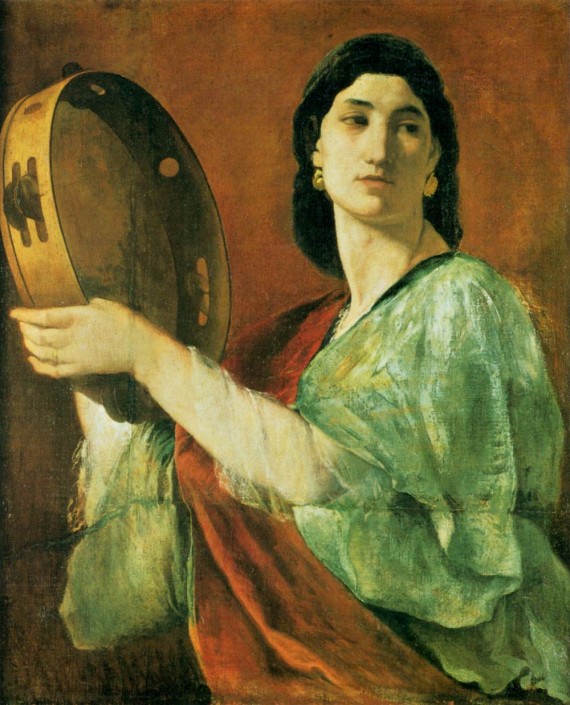
Initially, there is a family dispute at the top of the group between Moses and his brother Aaron and sister Miriam, over the issue of sibling rivalry with God’s favor.

Miriam in happier days
Miriam winds up on the losing stick of that dispute, and is struck with leprosy (which clears up in a week after seeking and receiving God’s mercy through the intervention of Moses).

Korah, Dathan, Abiram, and 250 or so of their fellow rebels in the priesthood aren’t so lucky.

Korah’s sin amongst the Levites was to believe that all people (specifically, all Israelites) were intrinsically holy, and that God dwelt amongst them to a person (“all the congregation are holy, every one of them, and the LORD is among them”).


The Rebellion of Korah
Dathan and Abiram of the Tribe of Rueben reject Moses’ call for them to stand up against the rebellion of Korath.  From their view, Moses hadn’t accomplished all that much other than causing the Israelites to depart from the comfort of Egypt only to die in the wilderness, so if Moses had an issue with someone not following his rules, that was Moses’ problem, not Dathan and Abiram’s problem.

Mistake.

The end of Korah
Moses proposes a sacrifice throw-down of burnt incense, and Korah and his men lose and are being swallowed up by the earth.  Dathan, Abiram, and their families share a similar fate and are consumed by fire.

Which emphasizes the following rules:

1) Whatever survives burning is thus holy (and so Korah’s censers were recycled into an alter-cover), and

2) An outsider to the priesthood who approaches the LORD to offer sacrifice shall be put to death.

The trip started with a total of 603,550.

It ends at the edge of the Jordan with a little less, amounting to 601,730.

All who had originally escaped the human bondage of Pharaoh (except Moses, Joshua, and Caleb) have perished in the wilderness.

Almost ready to enter the Promised Land.

Almost.

In any event, one of my favorite blessings is found in Numbers, and here it is:

May the LORD bless you and keep you;
the LORD make his face shine upon you and be gracious to you;
the LORD lift up his countenance upon you
and give you peace, wholeness of life, Shalom.

Peace be with you.

Monday, October 10, 2011

Are we there yet?


Do you remember going on a family trip?

Dad behind the wheel, driving and getting mighty irritated at the misbehaving kids in the back seat who had been told to behave.

Turning around to remind them to KNOCK IT OFF, OR ELSE!

That’s kind of how Numbers is turning out to be.

Although initially saved in Exodus through the provision of food in the form of heavenly manna, the Israelites seem to have gotten tired of eating it.

The Israelites gathering manna
And commence to complaining to God about it.

Which is a mistake.

But it does lead to a fairly hilarious rant by God in response to the Israelites’ complaints about manna.

“You want meat?” says God: “I’ll feed you spoiled brats meat ‘til you puke!”

Actually, God says :“You shall have meat until it comes out of your nostrils.”

Which is pretty close to if not exactly the same thing.

Unfortunately, the Israelites don’t pick up on God’s not so subtle hint that He is more than just a little ticked off, and proceed to continue to complain while on their trip to the Promised Land of Canaan.

This time, it is in response to the spies who identify a land of plenty but who feel that the Israelites might be somewhat outnumbered and overmatched.

Rather than looking to God and take the position that He will help them prevail, the Israelites begin carping about their situation, and of how they wished they were back under human bondage by their fleshpots in Egypt.

And of how they wished they were dead.

Which is the wrong thing to wish for around God.

Because he in essence grants their wish.

No carping Israelite will reach Canaan 

All the “sinful generation” will perish in the wilderness.

Of the over 600,000 at the beginning of the trip, only two, Joshua and Caleb, will make it across the Jordan.

Saturday, October 8, 2011

Absolute rules

No blood, no fat.

Period.

That's what Leviticus says.

I have prepared food.

I've been told that I'm a pretty good cook.

And I know that there is no way, no possible way, to prepare any form of meat with absolutely no blood and no fat.

It is not humanly possible.

Sure, you can kid yourself that most of the blood is gone, and that you've bought lean and cut out most of the fatty pieces that might remain (which you should do in any event if you've made the choice to eat meat, according to generally accepted modern science and medicine).

But there will be some blood and some fat that remains.

Unless you have charred the piece of meat to ashes.

Try it.

Go ahead, try it.

Not going to happen in this world.

That is just the way it is.

Leviticus tells us that there are some forms of meat that can be consumed and still be holy.

So long as there is no blood and no fat.

Leviticus also prohibits (among other things) consumption of certain specified animals, including the hoopoe, which I thought initially was a goof, but is in fact a real animal.


The Hoopoe 

I'm not sure I'd ever be able to catch hoopoe, let alone want to eat one, in the real world.

So not eating a hoopoe and remaining holy, for me, isn't really an issue.

There are a number of things that are specified in Leviticus as unholy, such as homosexuality, that I've never really considered in my personal life to be an issue.

Because I'm not homosexual.

Must be lucky, in the sense of trying to be holy in the eyes of God, at least in the way that Leviticus presents the situation. 

So I've really never had the opportunity to consider how I would feel if the inspired word of my faith provided that I should be stoned to death simply for being what God made me to be.

At least the science of genetics suggests that such a human condition isn't a matter of human choice.

Sure, one's action in pursuit of sexual gratification is a matter of choice.

Doing something which is not natural might be a basis for consideration as a problem. 

But that probably isn't the case for a majority of homosexuals.

Perhaps altering one's native drive might be the perversion that is intended to be addressed in the infamous verse from Leviticus.

A perversion such as forcing or advocating a homosexual to engage in heterosexual conduct.

Kind of like sexual relations with other species.

Which, as it turns out, is specifically prohibited in Leviticus.

And which, again, is not a problem for me.

Thank God.

I've never desired to hook up with a hoopoe.

In any event, whatever its source or explanation, I'm fairly confident that experiencing thoughts that one is abhorred by God simply by reason of the way they were born would not be all that pleasant.

Back to those things that have some bearing on me.

Such as the issue of what I can consume as food and remain holy.

If I can eat certain animals, but can't eat their meat with any blood or fat, all that will be left is ashes.

And you can't get too far living on ashes.

With this conundrum in mind, it is difficult, if not impossible, for one who believes that they have faith to read the inspired word of God without becoming somewhat of an apologetic.

There.

I've said it.

Hopefully, having said that, I won't be consumed by flame.

As did Nabad and Abihu, sons of Aaron, for providing offerings considered unholy in their sincere sacrifice to God.


Nadab and Abihu preparing for sacrifice 

With all that is available for consideration as to the basis and formation of what remains after the historic revision and editing of the text reflecting the expostulation of what has transpired in the interaction between the divine and humankind, any level of reflection by a thinking individual on the meaning of what is written begs several questions:

How does the divine want the created (those who have been driven from the Garden of perfection) to address and resolve explicit rules which in His world cannot by human means be accomplished?

How are we to address the cognitive dissonance of the inspired word of God and remain holy?
Is it contextual? 
Is it interpretive relative to modern sensibilities?

Is the inspired word of God to be amended depending on what we think it should say?

Is it to be rejected as an ancient superstition of a God that has never existed, or a God so mercurial that a sincere intent to comply with His rules doesn't matter?

Those with faith and those who think (with whom your author condemns himself) struggle with those propositions.

I would prefer not end up as ashes like Nabad and Abihu for blowing the rules when trying to satisfy God.


Nadab and Abihu's unfortunate end as depicted in the
Nuremberg Bible 
At least I have no tattoos.

And (although I cannot admit that those who seek to lead my society advocate the same view) I individually do not oppress aliens who reside with me. 
I would, if I could, allow them to be as a citizen.

And I try, as hard as it may be, to love my neighbor as myself.

That's what Leviticus says I should do.

Friday, October 7, 2011

The Scapegoat

I’m now reading Leviticus, and wondering if people actually did this stuff.

It’s an instruction manual for a slaughterhouse.

A cookbook for ritual mayhem.

Clearly, PETA was not around when the korban (animal sacrifice through burnt offerings) was being practiced.

But it makes me consider whether I truly appreciated the sacrifice of the formerly animate being that went into this morning's breakfast.

And my afternoon lunch.

And what may be in this evening’s repast.

Thinking like that might turn me vegan.

Which is what we were when we were back in The Garden (at least that’s what Genesis says--- humans were only allowed to start eating animals after we got booted out of Eden).

Too bad that the smoke of the offering by fire is such a pleasing odor.

Perhaps such things are best left to God.

But that would mean no more barbecues.

Nuts!

Anyway, at some point, the modern reader has to step back from the writing and ask…

“What does this mean?”

In all seriousness, imagine if, out of the blue, someone approached you while walking down the street and told you:

“The inspired word of God says that there is some benefit to you to kill an unblemished newborn lamb in the following way…”

“Or you will not be walking with God.”

“You will be cut off.”

“You will be abhorrent.”

“An abomination in this world.”

“And in any world to come.”

Leviticus outlines in detail the specifics of sacrifices designed to afford harmony between God, humanity, and the world. 

It specifies rules concerning what, how, and where things are to be sacrificed, who is allowed to participate in the ritual ceremonies, identification of things that are unclean and what needs to be done to cleanse things that have come in contact with them, and various prescriptions of how to be holy, including issues of food, sex, and acting neighborly, among others.

Such practices which maintain the relationship between God and humankind. 

It outlines cultic ritual sacrifices for the removal of evil, atonement for sin, healing of the sick, abatement of troubles, and the restoration of cosmic unity with the divine.

And it makes some sense, coming from an agrarian society that traces its beginnings to shepherds.

Consider the dealings of Jacob (pre-wrasslin’ match with God when he was still Jacob, not Israel) and Laban where Jacob created his flock of sheep through ingenious methods of animal husbandry, and Moses before Pharaoh immediately prior to the plague of the first born, where God hardened Pharaoh’s heart to deny release of the Israelite’s animals (which was the last straw as far as God was concerned).

Wealth and stature in the community were based on the ownership and control of sheep, goats, and other animals. 

Giving that which is most dear is the highest form of sacrifice.

Leviticus also outlines the need to create a place for the Almighty to dwell, emphasizing that it must be holy, cleansed of pollution and free from impurities.

And it describes the practice of the annual ritual cleansing of the Temple of the sins which have accumulated over a year on the Day of Atonement.

Yom Kippur.

Which, by chance, luck, or providence, begins this evening at sundown.

The specific ritual involves a young bull, a ram, and two goats.

One of the goats is offered for a sacrifice to the LORD.

And is slaughtered in a fairly gruesome fashion.

The other is to bear all the sins and iniquities of the children of Israel.

Yet it lives.

The Scapegoat
That goat is known as the scapegoat, and survives the ritual sacrifice to be released in the wilderness.

The scapegoat for Azazel, the “fierce and angry god.”

A foreshadowing of what is to come in Numbers, addressing the wanderings in the wilderness of the sinful generation of the Israelites.

And also a foreshadowing of things to come in the New Testament.

Which begs a question appropriate to consider on the Day of Atonement:

Is it better to bear the sins of the community in the wasteland...

and live,

Or to give of your life to be the sacrifice... 

and be united with God?